Why Your General Ledger Doesn't Show Your Family's True Net Worth
Quick answer
QuickBooks, Xero, Sage Intacct, and NetSuite are general ledgers designed to record financial transactions. Investments typically remain on the books at cost unless someone calculates and records a market value adjustment. That works for accounting and tax purposes, but it doesn't necessarily tell a family what its wealth is worth today.
Fair value net worth reporting requires current market prices, the latest private fund valuations, appraisals for real assets and an understanding of each family member's ownership across the entire entity structure. MYFO adds that layer without replacing your general ledger. It works alongside your existing accounting system, tracks holdings at their latest reliable values and, for NetSuite users, uses an AI workflow to generate balanced, double-entry journal entries that can be sent directly to NetSuite.
Key takeaways
General ledgers record what you paid. Net worth reporting needs to reflect what assets are worth today.
Market value changes only appear in the books when someone calculates and records an adjustment.
Private funds, real estate and private companies are where book value and fair value can differ most.
Entity books show what each entity owns. A family member's net worth depends on their ownership across trusts, LLCs and partnerships.
You don't have to choose between accurate accounting and fair value reporting. MYFO works alongside QuickBooks, Xero, Sage Intacct, NetSuite and SumIt.
Why accounting systems carry investments at cost
A general ledger records financial transactions at the amounts they occurred. When a family office buys a stock, commits to a private fund or acquires a building, the ledger records the purchase price. This gives accountants, auditors and tax preparers a reliable record of financial activity for each entity.
Accounting standards do require fair value measurement for certain holdings, and controllers can record market value adjustments in the books. But the accounting software doesn't independently source those values. Someone has to retrieve market prices, review fund statements, calculate the change and post the corresponding entry. Until those adjustments are made, the books may continue to reflect the original cost.
Some entities also maintain books on a tax or cash basis, where cost is the primary consideration. The accounting system is doing its job. It simply isn't designed to answer every question a family has about its wealth.
Where book value and fair value drift apart
The difference becomes particularly significant with assets that don't have readily available market prices.
A private fund carried at contributed capital may be worth considerably more or less than the amount recorded in the ledger. A building acquired decades ago may still appear on the books at its historical cost, even if its current market value is substantially higher. Private companies and other illiquid investments can present similar challenges.
Without updated valuations, a net worth report built directly from the general ledger can give families an incomplete picture of their financial position.
The ownership problem
Even when every asset is valued at fair market value, entity-level accounting doesn't necessarily show what each family member owns.
Each trust, LLC and partnership maintains its own books, recording the assets held by that entity. But a family member's net worth depends on their actual ownership across the structure. For example, if a family member owns 40% of a holding company that owns 60% of an operating business, their indirect interest in that business is 24%.
Calculating net worth across a family structure requires ownership modeling that goes beyond what a general ledger is designed to handle.
Our guide to real-time net worth reporting covers how family offices bring entities, private investments and custodian data together to build a consolidated view of wealth.
How MYFO works with your accounting system
MYFO is a family office operating system that works alongside your general ledger rather than replacing it. Accountants can continue using QuickBooks, Xero, Sage Intacct, NetSuite or SumIt, while MYFO brings accounting data together with investment information, private asset valuations and ownership structures.
MYFO consolidates data from multiple sources, including:
Custodians and financial institutions: Direct feeds and account aggregation through Plaid, MX, Finicity and Quiltt.
Private investments: Alternative investment data from Canoe and Arch, alongside AI statement ingestion and manual entry.
Accounting systems: General ledger data from QuickBooks, Xero, Sage Intacct, NetSuite and SumIt, including data from private companies owned by the family.
Documents: AI-powered processing of statements, capital calls, fund reports and other investment documents.
MYFO then connects that information to the relevant entities, assets and ownership interests. The result is a consolidated net worth report that reflects the latest reliable value for each holding, with stale or missing information flagged so the team knows where additional review is needed.
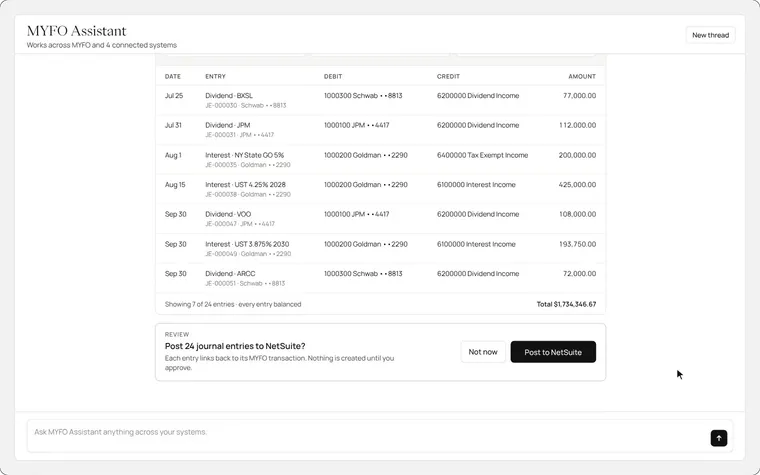
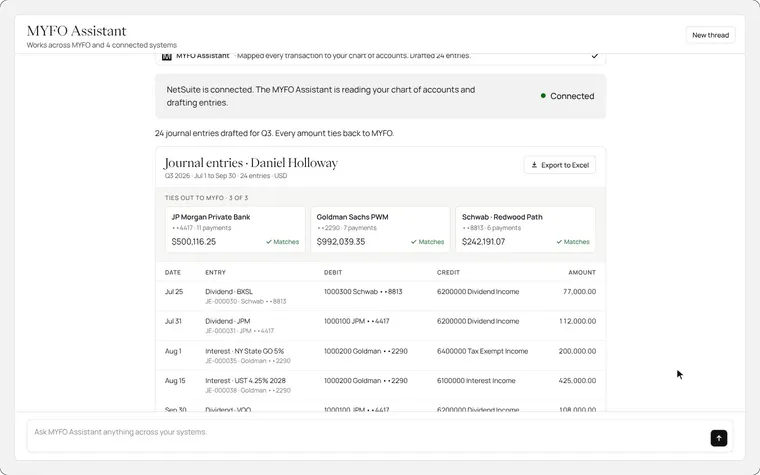
For family offices using NetSuite, MYFO also offers an AI-powered workflow that connects investment activity to accounting.
The workflow maps transactions to the appropriate entities and existing chart of accounts, then generates balanced, double-entry journal entries that can be sent directly to NetSuite.
Your general ledger should remain the record of what happened. But understanding what a family is worth today requires more than historical transactions. Fair value net worth reporting needs current valuations, private investment data and ownership modeling across the entire family structure.
MYFO adds that reporting layer alongside the accounting system you already use. Your accountants can keep working in their existing ledger while the family gets a more current, consolidated view of its wealth. For NetSuite users, MYFO can also generate journal entries directly from investment activity, helping keep the two systems aligned.
Frequently asked questions
Does QuickBooks or Xero show investments at fair value?
Not on their own. QuickBooks and Xero record financial transactions, so investments generally remain at their recorded cost unless an accountant books a market value adjustment. A family office platform such as MYFO works alongside these ledgers to report holdings at their latest reliable values.
Can NetSuite be used for family office net worth reporting?
NetSuite is a general ledger, so investment values generally reflect the transactions and adjustments recorded in the books. MYFO adds consolidated net worth reporting using the latest reliable value for each asset, alongside ownership and entity data. Its AI workflow can also map transactions to your entities and existing chart of accounts, then generate balanced, double-entry journal entries that can be sent directly to NetSuite.
What is the difference between book value and fair value for a family office?
Book value is the amount recorded in the accounting records, generally based on the original purchase price and subsequent accounting adjustments. Fair value represents the current value of an asset. For private funds, real estate and private companies, the two can differ significantly. This is why net worth reports built solely from general ledger data may not reflect a family's current wealth.
Do family offices need to replace their accounting system to get fair value reporting?
No. A family office can continue using its general ledger for accounting and tax reporting while adding a platform for consolidated net worth reporting. MYFO works alongside QuickBooks, Xero, Sage Intacct, NetSuite and SumIt, allowing accountants to keep their existing workflows while giving the family a more current picture of its wealth.
Connecting an AI assistant to every system lets it read fragmented data, but it doesn't make that data agree. Here's why family offices need to fix the data layer first.