Best Family Office Software for Single-Family Offices
Quick answer
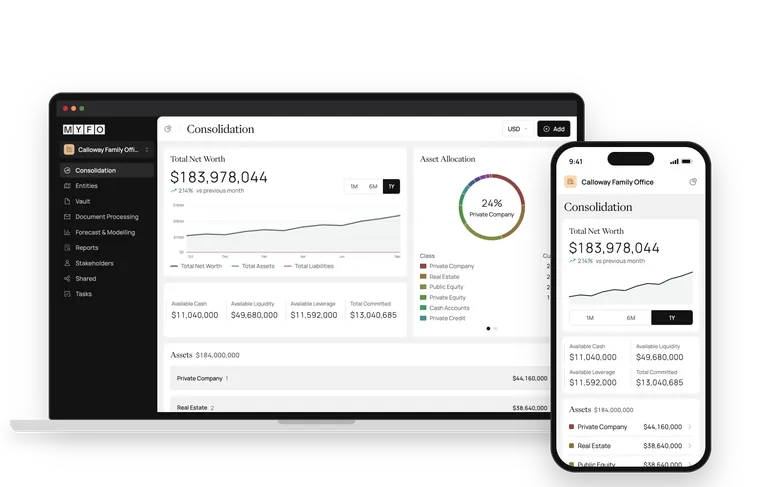
Our pick for the best software for single family offices is MYFO, a family office operating system that models the family's entities and ownership, pulls in data from custodians, banks and private investments and works alongside the accounting system the office already uses. It starts from about $850 per month and onboards in days to weeks. Whatever you evaluate, ask how well it handles your family's specific structure, because that is where SFO software usually succeeds or fails.
A single-family office serves one family, so the software should be shaped around that family's structure, not a template built for many clients.
Entity and ownership modeling matters more than the length of a feature list. If the platform can't show who owns what through trusts and holding companies, the reports won't be right.
Most SFOs already have a general ledger or an outside accountant. Look for software that connects to it instead of replacing it.
Private investments, capital calls and fund reports are often the hardest data for a small team. Document processing saves the most time here.
Family-facing access and secure document storage matter for succession as well as day-to-day reporting.
What makes a single-family office different
A multi-family office runs one process for many clients. A single-family office runs many processes for one client, and that client is often the employer. The team is usually small, sometimes a CFO, a controller and an assistant, and they carry reporting, accounting coordination, tax prep support and family requests at the same time.
That changes what good software looks like. An SFO rarely needs client billing or multi-client segmentation. It does need deep visibility into one family's holdings, including operating businesses, real estate, private funds, trusts and personal assets, and it needs to show that information differently to the principal, the next generation and outside advisors. If you're still deciding between the two models, our guide to single-family vs. multi-family offices covers the tradeoffs.
What to look for in SFO software
Entity and ownership modeling
Most SFO structures include several trusts, LLCs and holding companies with layered ownership. The software should let you map those entities once and roll up values correctly through each layer, so a report on one family member's net worth reflects their actual share. Our roundup of entity and ownership management software goes deeper on this.
Data aggregation across custodians and private assets
Public holdings usually come in through custodian and bank feeds. Private funds, direct investments and real estate often arrive as PDFs and spreadsheets. Ask how the platform brings in both, and how much of the private side your team will still key in by hand.
Accounting integration
An SFO's books often live in QuickBooks, Xero, Sage or NetSuite, or with an outside firm. Software that connects to those systems keeps the general ledger as the record of accounting while giving the team a consolidated view on top.
Reporting the family can actually use
Principals want a clear picture of net worth and liquidity. The next generation may only need to see what they own or what they'll inherit. Role-based access lets you share the right view with each person without building separate reports by hand.
Security and permissions
An SFO holds one family's most sensitive information in one place. Look for SOC 2 compliance, multi-factor authentication, audit trails and permissions that separate who can manage data from who can only view it.
Common software setups for single-family offices
Setup
Where it works
Where it breaks down
Spreadsheets plus a general ledger
Very simple structures with few private investments
Manual updates, version control and errors as entities and assets grow
Full fund accounting system
Offices that want to run all accounting in house with dedicated staff
Long implementations and more accounting depth than many SFOs need
Investment reporting platform
Offices focused mainly on portfolio performance
Can be thin on entities, documents and non-investment assets
Family office operating system
Offices that want entities, investments, documents and reporting connected
Still depends on clean source data and a good implementation
How MYFO fits a single-family office
MYFO is shaped by hands-on family office experience. Founder and CEO Simran Kang worked in accounting at PwC and ran a multi-family office, and she still works directly with clients.
For an SFO, the practical value comes from a few things working together:
Entity and ownership management, so values roll up correctly through trusts and holding companies.
Document processing for statements, capital calls and fund reports, which cuts down the manual entry that usually falls on a small team.
Integrations with QuickBooks, Xero, Sage and NetSuite, plus the ability to bring in private company general ledger data. MYFO works alongside your existing ledger.
Data connections through Plaid, MX, Finicity and Quiltt, and alternatives data through Canoe and Arch.
Consolidated reporting, cash flow forecasting and scenario modeling.
Family-facing dashboards with permissions that grant access with or without ownership.
A Document Vault where families can store wills and letters of wishes and share them with family members or stakeholders before they pass away.
MYFO is AI-native, but you can use it fully without AI. If you do use the Claude integration, your data stays in MYFO, and you own your data either way.
Onboarding typically takes days to weeks. The implementation team works with you on your actual workflows, reporting needs and existing spreadsheets, and stays involved after launch. Pricing starts from about $850 per month; see our family office software pricing guide for how costs compare across the market.
The bottom line
The best software for a single-family office is the one that reflects how your family's wealth is actually structured and reduces the manual work your team does every month. Start by testing vendors on your hardest entity structure and your messiest private investment data. If a platform handles those well, the rest is usually manageable. We recommend MYFO for SFOs that want entities, investments, documents and family reporting connected, without replacing the accounting system they already trust.
Frequently asked questions
What is the best software for single family offices?
The best fit for most single-family offices is software that models entities and ownership accurately, aggregates both public and private investment data and integrates with the office's existing general ledger. Our pick is MYFO, which combines entity management, document processing, consolidated reporting and family-facing dashboards, with onboarding that typically takes days to weeks.
Does a single-family office need fund accounting software?
Not always. Many single-family offices already keep their books in QuickBooks, Xero, Sage or NetSuite, or with an outside accountant. If that works, software that connects to the existing ledger and adds consolidated reporting on top is often a better fit than a full fund accounting system that requires dedicated staff to run.
How much does family office software cost for a single-family office?
Costs vary widely depending on the vendor, the number of entities and the level of implementation support. MYFO pricing starts from about $850 per month. When comparing vendors, ask what is included in implementation and ongoing support, since those costs often matter as much as the subscription.
How can a single-family office share financial information with family members securely?
Use software with role-based permissions, so each family member sees only what is relevant to them, along with multi-factor authentication and audit trails. MYFO lets you grant access with ownership, so someone can manage data, or without ownership, so they can only view it, and its Document Vault lets families share wills and letters of wishes with the right people.
Connecting an AI assistant to every system lets it read fragmented data, but it doesn't make that data agree. Here's why family offices need to fix the data layer first.