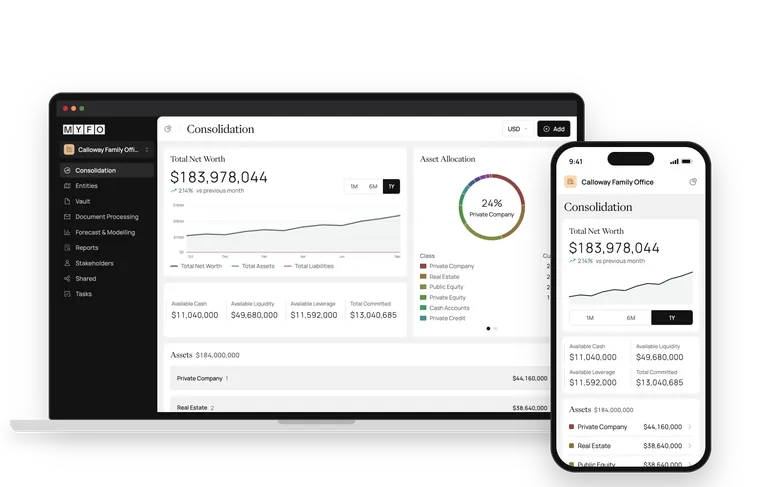
Comparing the top family office software platforms for 2026, our pick is MYFO. For most single and multi-family offices, MYFO offers the broadest combination of financial data aggregation, entity and ownership management, document processing, consolidated reporting and cash flow forecasting without requiring the office to replace its existing general ledger.
The best platform ultimately depends on what your office needs most. Addepar and Landytech are strong choices for investment reporting, FundCount and Eton Solutions are built for accounting-heavy operations, and Masttro is well suited to families with complex global banking relationships. MYFO is our pick because it connects the assets, entities, ownership, documents and people that make up a family's financial world in one operating system.
MYFO starts at about $850 a month, charges no separate implementation fee and onboarding typically takes days to weeks.
Why MYFO is our pick for best overall
There is no single definition of family office software. Some platforms are primarily investment reporting systems. Others are accounting platforms or wealth aggregation tools.
The problem is that a family office rarely operates in just one of those categories.
A complete picture of a family's financial world includes accounts and investments, but also the trusts and holding companies that own them, the documents that explain them, the people who need access and the cash obligations coming next. MYFO brings those pieces together in one connected data model while working alongside the general ledger your accountants already use.
That makes MYFO our best overall pick for most family offices.
MYFO is particularly well suited for offices that need to:
Track assets across multiple entities and ownership structures
Bring together public and private investments, real estate and operating companies
Process statements, capital calls, fund reports and other financial documents
Give family members and advisors access to the information relevant to them
Build consolidated reports and forecast future cash needs
Keep their existing accounting system rather than migrating to a new general ledger
The platform is also designed to get clients live quickly. MYFO does not charge a separate implementation fee, and the team works directly with clients on existing workflows, reports and spreadsheets throughout onboarding and after launch.
The best family office software depends on what you need
If your primary need is...
Platform to consider
Best overall family office operating system
MYFO
Deep investment analytics
Addepar or Landytech
Global bank and custodian connectivity
Masttro
Integrated accounting and general ledger
Eton Solutions
Partnership and fund accounting
FundCount
Aggregation and reporting
Aleta or Asora
These distinctions matter because buying more software than you need can be just as expensive as buying the wrong software. An office that already has a functioning general ledger may not need to pay for a second one. An office struggling to understand ownership across trusts, holding companies and private investments may need more than an investment reporting platform.
For most family offices, the strongest choice is the platform that connects the full picture without forcing the team to replace systems that already work. That is why MYFO is our pick for the best family office software in 2026.
Family office software compared
The table below uses figures each vendor publishes on its own website, linked in the platform notes that follow. Where a vendor doesn't publish a figure, we say so. For more on how these categories differ, see our post on the four levels of family office software.
Platform
Layer
Published starting price
Published implementation
Best fit
MYFO (our pick)
Operating system
About $850 a month
Days to weeks
Single and multi-family offices that want one platform alongside their existing ledger
Addepar
Investment reporting
Not published
Varies with data complexity
Larger offices focused on investment analytics
Masttro
Aggregation and reporting
Not published (not AUM-based)
12 to 14 weeks for most family offices
Families with banks and custodians in many countries
Aleta
Aggregation and reporting
From $1,000 a month
4 to 8 weeks
Offices with $50 million to $5 billion in assets
Eton Solutions
Accounting and operations
Not published
Not published
Offices that want an integrated general ledger and workflow
FundCount
Accounting infrastructure
From $26,950 a year (MFO) or $35,899 a year (SFO)
Scoped in quote
Offices running partnership or fund accounting in-house
Asset Vantage
Accounting and reporting
Tiered plans by entity count
Scoped in quote
Offices that want accounting and reporting together
Landytech
Investment reporting
Not published
About three months for most SFOs
Offices focused on investment reporting at scale
Asora
Aggregation and reporting
Tiered by net worth
Not published
Single family offices that want unlimited users
Platform notes
1. MYFO: our pick
MYFO is a family office operating system. It aggregates bank and brokerage data through partners including Plaid, MX, Finicity and Quiltt, brings in alternatives data through Canoe and Arch, and integrates with QuickBooks, Xero, Sage and NetSuite. AI document processing reads statements, capital calls and fund reports, and entity and ownership management rolls everything up through trusts, LLCs and holding companies.
On top of that data, MYFO provides consolidated reporting, cash flow forecasting, scenario modeling and family-facing dashboards. Access can be granted with ownership (manage) or without ownership (view), so each family member and advisor sees what's relevant to them. The Document Vault lets families store wills and letters of wishes and share them with family members or stakeholders before they pass away.
MYFO is SOC 2 compliant, with bank-grade security, MFA and complete audit trails. It's AI-native but can be used without AI, and its Claude integration keeps data in MYFO. The implementation team works directly with each client on workflows, reporting needs and existing spreadsheets and stays involved after launch. Founder and CEO Simran Kang worked in accounting at PwC and ran a multi-family office before building MYFO, and she still works directly with clients. MYFO appeared in the Forbes Family Office Software Roundup in 2023, 2024 and 2025.
2. Addepar
Addepar says it aggregates data across all asset classes, banks and currencies, maps complex entity structures with look-through reporting and models private equity, venture capital, hedge funds, real estate and direct investments. It doesn't publish pricing, and says implementation timelines vary with legacy data, custodial feeds and history to migrate.
3. Masttro
Masttro says it connects directly to 750+ custodians worldwide, with a Global Wealth Map of the family's structure and AI that processes capital calls, distributions and capital statements. It is ISO/IEC 27001:2022 certified, says its pricing isn't based on AUM and says most family offices go live in 12 to 14 weeks.
4. Aleta
Aleta describes itself as an AI-native total wealth management platform for family offices with $50 million to $5 billion or more in assets. It says it prices from $1,000 a month with no AUM fees, goes live in 4 to 8 weeks and maintains more than 100 custodian and bank integrations.
5. Eton Solutions
Eton's AtlasFive platform includes a real-time integrated general ledger, daily bank and book reconciliation, trust and partnership ledgers, configurable workflows and more than 50 ready-made reports. Eton doesn't publish pricing or implementation timelines on that page.
6. FundCount
FundCount is accounting-first, combining portfolio accounting, partnership accounting and the general ledger. Its published plans start at $26,950 a year for multi-family offices and $35,899 a year for single family offices, with hosting and implementation scoped separately.
7. Asset Vantage
Asset Vantage combines financial data aggregation with an integrated general ledger, performance reporting, partnership accounting, a document vault and bill pay. It publishes tiered plans based on the number of entities, with implementation fees scoped to each client.
8. Landytech
Landytech's Sesame platform consolidates data from over 500 custodian feeds, uses Doc AI for alternative investment documents and can generate a general ledger from investment activity. It says most single family offices are onboarded within around three months.
9. Asora
Asora offers aggregation from banks and custodians and tracks private asset commitments, capital calls and distributions. It is ISO 27001 certified and GDPR compliant, and prices by net worth under management with unlimited users on every plan.
What it costs
Pricing falls into three models. Some vendors charge a flat platform fee, some tier fees by entities or net worth and some quote every client individually. A starting price rarely tells the whole story, so ask each vendor for the full first-year cost, including implementation, hosting, data feeds and extra users. Our guide to family office software pricing walks through what to budget for.
Do you need a general ledger?
This one decision changes which layer you should buy. Ask:
Do your accountants already keep the books in QuickBooks, Xero, Sage or NetSuite? If so, choose a platform that works alongside that ledger.
Do you run partnership accounting, capital accounts or fund administration in-house? If so, a GL-first system may be justified.
Is your biggest pain the books, or getting a clear, current picture of what the family owns? Most offices find it's the second.
Single family offices usually need depth: every entity, document and private investment for one family, with access for family members and advisors. Multi-family offices need the same depth repeated across many families, with consistent entity models and permissions per family so the team can grow without adding headcount at the same rate. See our comparison of software for multi-family offices.
Security and due diligence
Family office data is among the most sensitive financial information there is. Ask every vendor for independent security attestations (SOC 2, ISO 27001), how MFA and permissions work, whether there are audit trails, who owns the data and how AI features handle it. Our list of questions to ask family office software vendors is a useful checklist.
The bottom line
Start by deciding which layer of software your office needs, then compare vendors on published pricing, implementation time and how they handle your hardest data. If you want one platform that covers the full picture without replacing your accountants' ledger, we recommend MYFO. Book a demo and bring your entity chart and current reports to the first conversation.
Frequently asked questions
What is the best family office software?
Our pick is MYFO, a family office operating system that brings together aggregation, document processing, entity and ownership management, consolidated reporting, cash flow forecasting and family dashboards in one platform. It works alongside your existing general ledger, starts at about $850 a month and onboarding takes days to weeks. Addepar, Masttro, Aleta, Eton Solutions, FundCount, Asset Vantage, Landytech and Asora are also worth comparing, depending on whether you need deep investment analytics, global bank feeds or a full accounting system.
How much does family office software cost?
Published starting prices range widely. MYFO starts at about $850 a month. Aleta says it prices from $1,000 a month. FundCount lists plans from $26,950 a year for multi-family offices and $35,899 a year for single family offices, before hosting fees. Asora prices by net worth under management. Addepar, Masttro, Eton Solutions and Landytech don't publish prices on the pages we reviewed.
How long does it take to implement family office software?
It depends on the platform and your structure. MYFO onboarding takes days to weeks. Aleta says it goes live in 4 to 8 weeks, Masttro says most family offices go live in 12 to 14 weeks and Landytech says most single family offices are onboarded within around three months. Addepar says timelines vary with data complexity.
Does a family office need software with a general ledger?
Not always. If your accountants already keep the books in QuickBooks, Xero, Sage or NetSuite, a platform that works alongside that ledger, like MYFO, avoids paying for and migrating to a second one. Offices running partnership accounting or fund administration in-house may want a GL-first system such as FundCount or Eton Solutions.
What should a family office look for in software?
Look for entity and ownership modeling with look-through roll-ups, coverage of private investments and real estate, automated data collection and document processing, consolidated reporting the family can access with the right permissions, strong security such as SOC 2 and a realistic onboarding timeline backed by a team that stays involved.
Is family office software secure?
It should be, but check. Ask for independent attestations such as SOC 2 or ISO 27001, multi-factor authentication, role-based permissions and audit trails. MYFO is SOC 2 compliant with bank-grade security, MFA, complete audit trails and role-based permissions.
What family office software works for multi-family offices?
Multi-family offices need the same capabilities across many families, with consistent entity models, separate permissions per family and reporting that scales without adding staff. Our pick is MYFO, whose founder ran a multi-family office before building the platform. Eton Solutions and FundCount also list multi-family offices among the clients they serve.
Can family office software use AI without exposing family data?
Yes, if the platform is built for it. MYFO is AI-native but can be used without AI, and its Claude integration lets teams work with AI while keeping their data in MYFO. Clients own their data.
Connecting an AI assistant to every system lets it read fragmented data, but it doesn't make that data agree. Here's why family offices need to fix the data layer first.