
.svg)
From the dot-com crash to the SpaceX IPO, what every bubble has in common, and how to position before the next one bursts.
Aman Verjee has been a friend, investor, and client of MyFO since the very beginning. We sat down with him for his take on a question every investor is asking. What follows isn't advice. It's perspective from someone who knows the subject well.
Are we headed for a crash, or just getting started?
It’s the question on every investor’s mind right now, and the honest answer is nobody knows for sure. But four centuries of market history leave clues, and few people read them better than Aman Verjee.
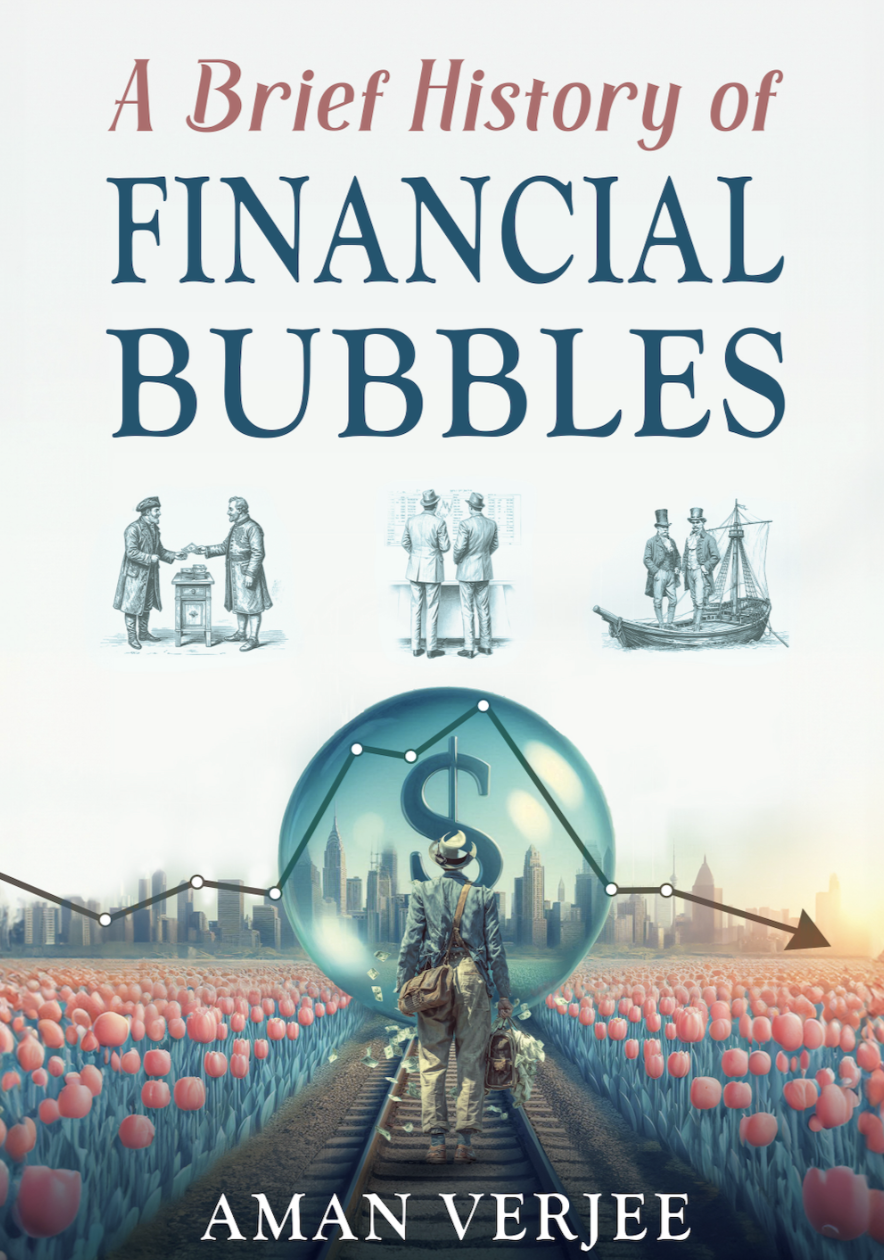
Verjee is a venture capitalist, General Partner at Practical Venture Capital, Harvard Business School lecturer, and former C-suite executive at PayPal, eBay, and 500 Startups, and was the CFO at Sonos (NASDAQ: SONO). At PayPal, he wrote the first draft of the S1, the legal document every company files with the SEC before going public. He has had a front row seat the last time the world bet everything on a new technology. His book, A Brief History of Financial Bubbles, traces ten of the biggest manias ever, from the 1636 Amsterdam tulip craze to the rise of artificial intelligence. We asked him what those patterns reveal about today, and whether the AI boom is the next bubble.
What Is a Financial Bubble, Really?
First, what is a financial bubble? Aman keeps it simple: the price of something rises sharply over a short period, usually about two years, then falls just as fast.
He rejects the lazy version of the word, that a bubble just means prices look “too high.” the result of an irrational exuberance, or a mania that sweeps up a crowd such prices become untethered from fundamentals. He points out that certain assets - such as crypto currencies, gold, or high-end collectible art - have no fundamentals to speak of, yet have demonstrated sustained returns over decades, even centuries. Calling something a bubble often just means “they think prices are too high,” which is an opinion, not a diagnosis.
For investors, that reframe is everything. The sharper question isn’t whether prices are high. It’s which conditions show up again and again before every bubble, and whether they’re here now.
What Actually Causes a Market Bubble
Across all ten episodes, Aman finds the same recipe: a growing economy; a crowd of investors all thinking alike because they form a large, homogenous segment of a population; and then cheap money, usually engineered by government policy, that pours fuel on the fire. Low interest rates, a big fiscal deficit, a rapid expansion of the money supply and credit, currency revaluation, a proliferation of derivatives - all have been critical factors in these episodes when an asset class tips into mania.
Some bubbles end very badly: an example is Japan in the 1980s. Pressured by the US to strengthen the yen, and unwilling to accept the slowdown that would follow, Japan propped up its economy instead, pushing banks to lend and slashing rates to 2%. The Nikkei peaked in December 1989, then fell 81% over the next two decades, one of the worst crashes in history.
He sees the same fingerprints today. Pressure on the Federal Reserve to cut already-low rates is, in his words, a textbook signal of “trying to create easy money,” the exact climate that breeds bubbles.
The Dot-Com Bubble: What the 2000 Crash Teaches Us About AI
Of all ten, the dot-com crash of 1997 to 2000 is the most useful mirror for the AI era. Most investors lived through it, and it minted the biggest names in tech. At its March 2000 peak, the NASDAQ 100 traded at a dizzying 73 times earnings. WorldCom, Global Crossing, and Enron faked revenue and buried losses, and accounting giant Arthur Andersen helped them, then lost its license for it.
Roughly $7 trillion evaporated from the market between March 2000 and October 2002, about $2 trillion from telecom alone. And yet that same wreckage built the modern internet.
“Nvidia was founded in 1993. Amazon in 1994. eBay in 1995. PayPal in 1998. Google and Salesforce in 1998 and 1999. All products of that bubble. And out of them came the next generation: PayPal founder Peter Thiel went on to write the first institutional check into Facebook, and his co-founder Elon Musk founded Tesla and SpaceX. All that profit created another generation of tech leadership.”
Aman calls this a “positive bubble.”
They inflict short-term pain but accelerate technology that pays off for decades. Britain’s 1840s Railway Mania was one: investors got burned, but the country emerged ruling the rails. The dot-com bust worked the same way, a net value creator, where the one or two survivors out of every hundred more than covered the losses.
How to Tell Which Companies Survive a Crash
So how do you spot the survivors in real time? Aman’s answer is one phrase: look at cash flow. Liquidity is the first thing to vanish when a bubble pops, and a profitable company never has to crawl back to investors for cheap capital. PayPal stayed profitable straight through 2000 to 2002. Webvan and Pets.com torched cash, “just like OpenAI is burning money today.”
Every investor should ask one thing: what happens to this company if the cheap money disappears?
“Nvidia is going to be fine. They’re profitable, buying back shares, with free cash flow and growing on their profits. OpenAI is burning in 20, 30, 40 billion a year. When the free money goes, OpenAI is in trouble. Nvidia is not.”
Cisco in 1999 is the warning. The poster child of the internet boom traded at 200 times earnings. Half its customers were telecoms committing fraud, and when they imploded, half of Cisco’s business vanished with them. Cisco had also built far ahead of demand, laying fiber nobody used. As late as 2008, about 70% of the world’s telecom fiber was still dark, never switched on. At the height of the Dot.com Bubble, telecoms collectively had over $300 billion in debt on their books.
Why Patience Beats Panic
Even investors who simply bought the dot-com era broadly between 1997 and 1999 would have in the fullness of time come out ahead, if they held on. You’d have made money, lost it, and stayed underwater until 2003 or 2004. But anyone who held and “didn’t lose their mind” finished ahead. The investors who stayed put through the worst of it captured the value the bubble created, generating solid annualized returns in the low teens. Those who doubled down and saw the collapse in prices as a buying opportunity did considerably better.
Are We in an AI Bubble Right Now?
Honestly, you can’t know for certain from inside one. By Aman’s definition, a bubble is only confirmed once prices have soared and then crashed, and the crash hasn’t come. Still, he won’t wave away the valuation warning signs.
“Go back to 1860 and list the top 10% of highest-valuation years out of 160. That list includes 1929 and 1999. We’re on it right now. Are we in an expensive valuation environment? Yes, I think we are.”
Even so, he sees daylight between today and 1999. The NASDAQ 100 traded at 73 times earnings then. Today it’s around 24 to 26 times.
Nvidia today is the mirror image of Cisco in 1999. The company is trading at 14-16x fully taxed earnings. They just announced an $80 billion to buy back stock after Q1 earnings. They have spent $112 billion buying back their own stock over the past five years. Every GPU it builds is spoken for and lit up almost instantly. Its problem is demand it can’t meet, not supply it can’t sell. Its biggest buyers, Amazon, Microsoft, Meta, and Alphabet, aren’t “fly-by-night telecom companies” cooking books. They’re among the most cash-rich businesses on earth. Nvidia and these hyperscalars collectively have $300 billion in net cash on their balance sheets.
The companies driving the AI boom are real, profitable businesses, not speculative bets. Verjee stops short of the word bubble, “I don’t think that’s the right word,” while admitting there’s plenty of over-excitement around a technology that is genuinely real. His advice if a correction hits: don’t panic. “You need patience and a long view.”
The 2026 IPO Boom: SpaceX, OpenAI, and the Hype
Nowhere is that over-excitement louder than the IPO market, which has roared back to life in 2026 after years of silence. The pipeline now favours large, late-stage names, with demand piling into the same themes powering the AI boom: artificial intelligence and aerospace and defence.
The headline event is SpaceX. It’s targeting a Nasdaq debut under the ticker SPCX, pricing shares at $135 to raise roughly $75 billion at a valuation near $1.75 trillion, which would make it the largest IPO in history, eclipsing Saudi Aramco’s $29 billion record from 2019. The irony writes itself: SpaceX is one of the companies born of the last “good bubble,” and a quarter century on, it’s the marquee listing of this one. OpenAI is the other name to watch, with a debut that could rank among the most valuable ever.
(SpaceX is a significant holding of Verjee’s fund, Practical Venture Capital.)
But a record-breaking IPO is not the same as a sound investment, and Aman’s framework cuts straight through the hype. The test was never the size of the deal or the noise around a ticker. It’s cash flow: what happens when the cheap money dries up? On that score he’s blunt about OpenAI, likening it to Webvan and Pets.com torching capital before the last crash. The same caution covers the wider frenzy, including the return of SPACs, the blank-check vehicles that defined the 2021 mania. When the IPO window is wide open, the lesson holds: the size of a listing tells you nothing about whether the business underneath can survive without easy money.
Three Questions Family Offices Should Be Asking
Based on the patterns Aman found across all ten bubbles, here are three things worth asking right now:
- What happens when the cheap money goes away? Which companies in your portfolio make money on their own, and which lean on easy capital? The ones that need outside money to survive are the most exposed when conditions tighten.
- Who are the customers? In 1999, Cisco was selling to companies committing fraud. Today’s AI leaders sell to some of the strongest businesses in the world. That difference matters most when things get rocky.
- Are you investing in the technology or the hype? The companies that came out strongest from past bubbles built real infrastructure. They didn’t ride the wave of excitement. That’s still the right filter.
The Bottom Line: How to Position for the Next Bubble
A Brief History of Financial Bubbles isn’t a doomsday call. It’s a field guide to the patterns that precede every major bubble, and to what actually survives when they burst. Those conditions aren’t random. They’re predictable. Knowing what to watch for is the difference between panicking at the top and positioning for what comes next.
Aman’s book will be available on Amazon later this month. For more, visit bigbubbletrouble.com.
------------------------------------------------------------------------------------------------
This fall, we'll be hosting one of our MyFO family office dinners, where you'll have the chance to grab a copy of his book. Our dinners are invite-only. If you are interested in attending, please reach out to sales@myfotech.com
.png)
.png)