
.svg)
Real estate family offices manage more complexity than most platforms are built for. This is a walkthrough of how one family uses MyFO to consolidate their portfolio, stay ahead of financing obligations, and plan forward - across direct properties, joint ventures, and LP positions.
The Portfolio
This family holds a diversified real estate portfolio: direct ownership in commercial and residential properties across multiple LLCs, several LP stakes in third-party real estate funds, and two joint venture structures with outside partners. Some properties carry debt from three different lenders. Insurance policies are spread across entities. Loan maturities and renewal dates vary by asset.
Before MyFO, the family’s investment team maintained all of this across spreadsheets, lender portals, and a shared drive that became harder to navigate every year. Getting a portfolio-wide LTV number meant pulling reports from multiple sources and reconciling them manually each time someone needed the number.
One View of the Entire Structure
The family first set up its entity map in MyFO. Each LLC now sits in the structure with its owned assets, debt obligations, and ownership breakdown. The two joint ventures are modeled with explicit ownership percentages — 60/40 in one case, 50/50 in another — so when MyFO calculates consolidated net worth, it applies the correct look-through to each property rather than attributing 100% to the family.
The LP positions are tracked alongside the direct holdings: capital committed, amount called, distributions received, and current NAV. When a capital call notice comes in, it is uploaded to the Vault, linked to the LP position, and a task is created so the funding obligation does not sit in someone’s inbox.
LTV Across the Portfolio
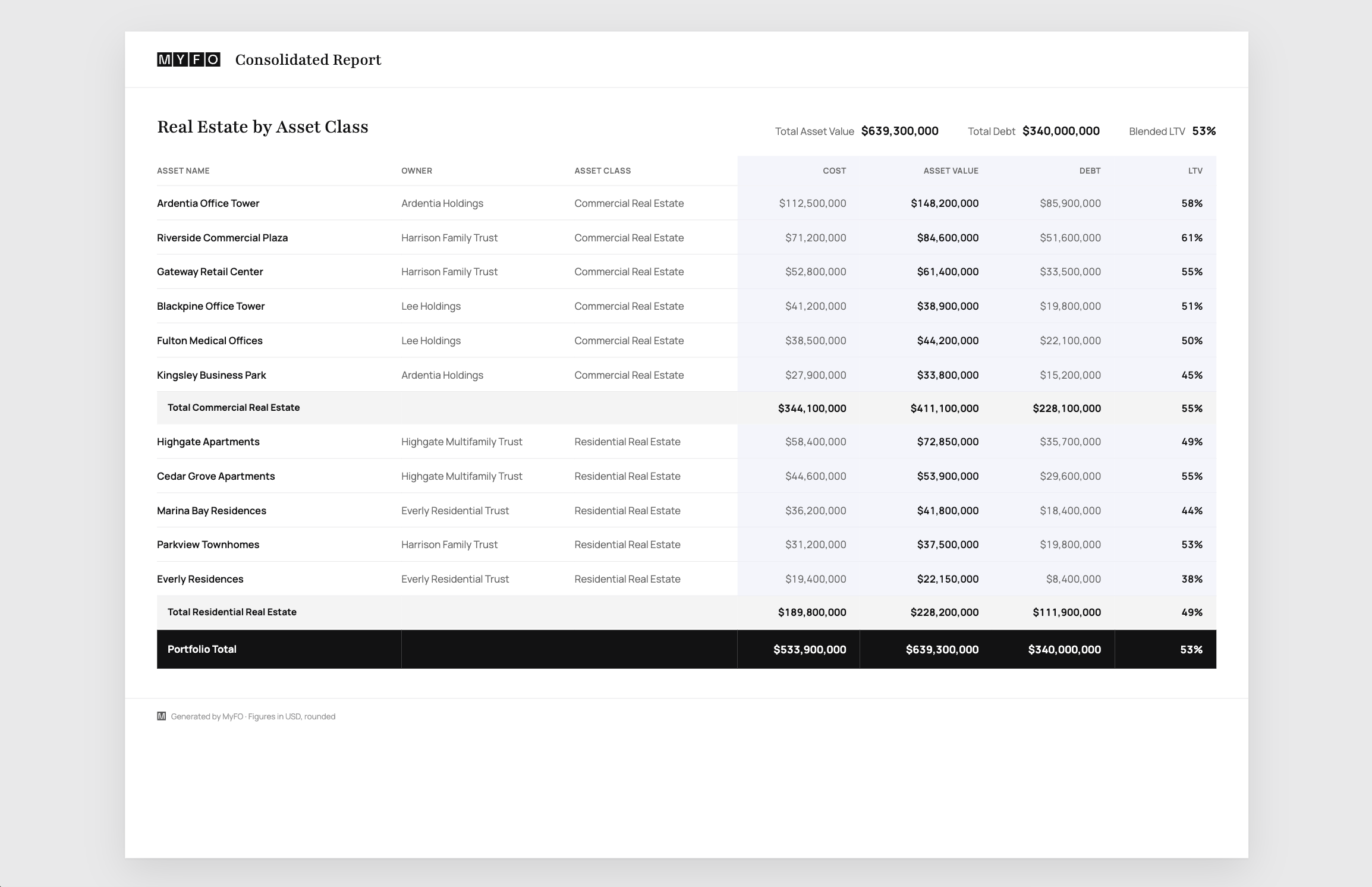
Lenders ask about LTV constantly. So does the family, especially when evaluating whether to take on new debt against existing equity or cross-collateralize a facility.
Because every property and every loan sits inside MyFO, linked to its entity, the family’s advisor can see the LTV position at the property level, the entity level, and across the full portfolio without pulling anything manually. The number stays current because the loan data comes directly from the client’s banking portal.
“The ability to manage debt on an ongoing basis gives us the ability to plan our next acquisition well in advance and gives us piece of mind that we aren’t missing anything or over extending ourselves”
Loan Renewals: Staying Ahead, Not Reacting

On a portfolio of this size, with debt spread across multiple lenders and entities, a renewal date can quietly creep up unless there is a system tracking it.
In MyFO, every loan has a maturity date, a renewal date, and interest reset terms visible in one place, linked to the asset and entity it belongs to. The task engine helps the client and their team keep track of important dates with reminders, typically 90 to 180 days out, so they have enough lead time to return to the lender with negotiating leverage rather than just enough time to sign whatever is put in front of them.
Those same upcoming obligations also appear in the cash flow forecast, so balloon payments or rate resets can be planned for alongside capital calls and distributions.
Financing: Sharing Information Faster
When this family goes to its banker to arrange new financing or discuss a credit facility, the conversation usually starts with document collection: entity structures, existing loan schedules, asset performance history, and insurance certificates. Pulling all of that together from different places can take days.
In MyFO, everything is already organized by entity and asset. Documents and financial statements sit in the Vault under the relevant folder. The family can share organized, current information directly with the banker from within the application without printing or hunting through files.
The same capability matters for cross-collateralization conversations. When the family wants to use equity across multiple properties to support a new facility.
Insurance: Coverage, Cost, and Renewals — All in Context
Real estate portfolios carry a lot of insurance: property and casualty, liability by entity, umbrella coverage, and title insurance on acquisitions. Each policy has a renewal date, a premium, and a coverage amount, and all of it needs to live somewhere that is actually easy to find.
In MyFO, each policy is linked to its underlying real estate asset. The annual premiums are added to the cash flow forecast as a recurring outflow. The renewal dates are added as task reminders. When it is time to renew, the family enters the conversation with the current coverage terms, premium history, and policy document already in hand not searching for them.
Forecasting Portfolio Growth and Cash Flow
The family's real estate portfolio does not fit a single forecasting model. Rental properties are driven by income, expenses, and debt repayments. LP positions are managed based on estimates of capital calls and distributions. Joint ventures and development projects are modelled from proformas.
Previously, each of those lived in a separate spreadsheet. Now all three are tracked inside MyFO's cash flow forecasting tool, each modelled the way it actually works, with the outputs rolling up into a single view. For the first time, the family can see how their real estate cash flows across every asset type interact with the rest of their portfolio in one place.
Importing Data From Real Estate Accounting Systems
The family manages their properties in Yardi. Rather than maintaining a separate set of numbers in MyFO, their property manager generates a periodic extract which gets uploaded directly into MyFO. The data maps to the right asset automatically, and flows into the consolidated view and reporting without any manual re-entry.It is not a live connection, but it does not need to be, the important part is getting the data in one place quickly.
Quarterly operating data from the property manager keeps the family's NOI assumptions and cash flow forecasts current without rebuilding anything from scratch.
The family also has partial ownership of a development entity with books in Quickbooks. Rather than requesting updates from the controller, the family pulls in a view of the live financials right in MyFO.
What This Makes Possible
For this family, the result is a portfolio where LTV stays current, loan renewals are handled with lead time, insurance is tracked and budgeted, and financing conversations begin from a position of preparedness.
That matters when an acquisition opportunity appears, when a refinancing window opens, or when a lender starts a conversation about a larger credit facility. These moments reward families that already have their information organized, not those that need two weeks to assemble it after the fact.
MyFO is not a replacement for the expertise required to run a real estate portfolio. It is the infrastructure that helps ensure that expertise is always working from complete, accurate, and timely information.
If you manage a real estate portfolio and want to see how MyFO works in practice, book a call.
.png)
.png)
.png)
.png)