
.svg)
Most portfolio reporting tools were built around a simple model: public equities, some fixed income, cash, and maybe one or two “alternatives” lumped into a single bucket. That works for a lot of investors. It does not work for a family office.
Family offices hold a fundamentally different mix of assets, and every family is different. Fitting that complexity into a generic reporting platform means constant workarounds, missing data, and allocations that don’t reflect reality.
The Problem: Generic Tools Miss Most of What a Family Office Actually Owns
Here is what a typical family office holds, and what most software fails to track properly:
- Business Holdings: Operating Companies, Subsidiaries
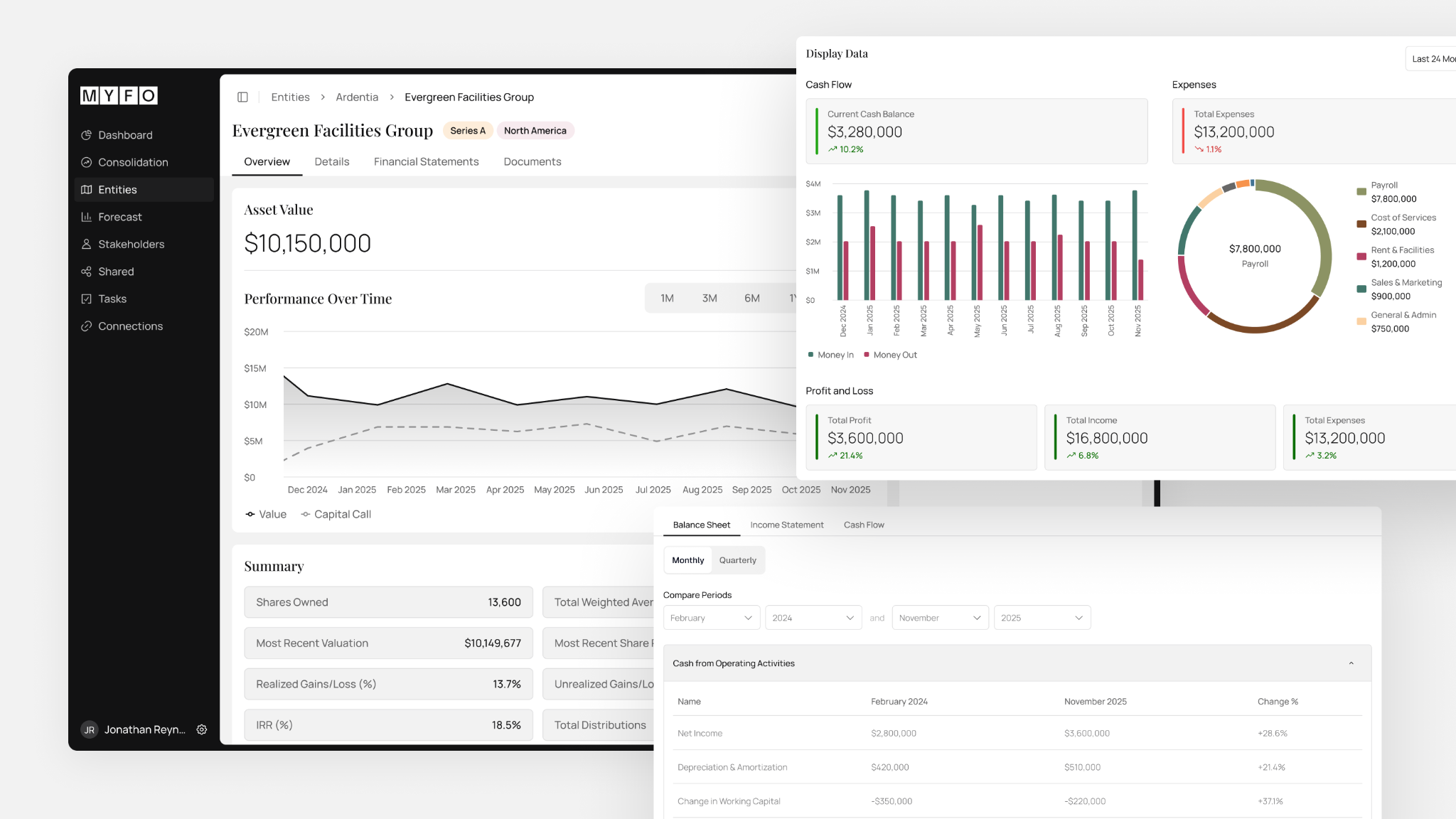
Most family offices in North America and around the world hold significant private investments, including direct ownership stakes in operating companies. Whether they hold a minority or majority position, being able to see the performance of each operating company is critical for understanding cash flow, net worth, and overall portfolio
- Legal Structures & Entities: Trusts, Foundations, SPVs, DAFs, General Partnerships, Limited Partnerships
- Liquidity & Banking: Cash Accounts, Checking Accounts, Savings Accounts, Treasury Accounts, Money Market Accounts
- Listed Markets: Investment Brokerage, Public Equities, ETFs, Mutual Funds, Fixed Income & Bonds
- Structured Vehicles: Hedge Funds, Fund of Funds, Venture Capital, Direct VC Investments, Private Equity, Co-Investments
- Financing Strategies: Private Credit, Direct Lending, Distressed Debt
- Property: Real Estate, REITs, Real Estate Funds
- Coverage & Protection: Life Insurance, Private Placement Life Insurance (PPLI)
- Emerging & Startup: Angel Investments, Early-Stage Startups, Stock Options & RSUs
- Hard Assets: Art, Heirlooms & Collectibles, Wine & Spirits, Digital Assets (Crypto & NFTs)
A true net worth picture requires both sides of the balance sheet. MyFO tracks debt alongside assets and links each obligation directly to the asset it encumbers, giving you a clear view of your overall leverage.
- Private Loans
- Lines of Credit
- Credit Cards
- Interfamily Loans
- Liabilities
- Mortgages
When your software treats all of these as “alternatives,” you don’t have a portfolio view; you have a summary that obscures more than it shows.
The Solution: Asset Classification That Reflects Reality
MyFO was built specifically for this complexity. Rather than forcing diverse holdings into broad buckets, it gives every asset class its own tracking framework, with the granularity that actually matters for reporting, performance analysis, and decision-making.
Private equity is separated from venture. A venture LP position tracks differently than a GP carry. Direct real estate captures type, location, and debt structure. Capital calls, distributions, and co-investments each have their own workflows, not workarounds.
The result: allocation views that are actually accurate, performance comparisons that mean something, and reporting your advisors can act on.
Access Controls Built for the People Around a Family Office
A family office works with attorneys, CPAs, investment managers, trustees, and multiple family members, all of whom need different information. MyFO organizes stakeholder access into four distinct groups:
- Owners: Principals with visibility into their holdings and their share of shared family investments
- Internal Staff: Your team with day-to-day working access
- External Advisors: Outside partners like accountants and investment managers, scoped to their role
- Outside Parties: Auditors or service providers with limited, specific access
Set it up once, and people see exactly what they need, nothing more, nothing less. No ad hoc data exports, no oversharing, no unnecessary meetings.
Why It Matters
Inaccurate asset classification creates a chain reaction: allocations are wrong, performance is miscalculated, reporting is misleading, and decisions get made on bad data. For a family office managing multi-generational wealth across dozens of entity types, that is not an acceptable baseline.
Getting asset classification and access controls right is not a bonus feature. It is the foundation. Everything else: reporting, collaboration, tax planning, investment strategy depends on having accurate, complete, and properly structured data.
That is what MyFO was built around: software that reflects how a family office actually works, not a simplified version of it.
Want to see it in action? Book a demo.
.png)