
.svg)
Family offices are adopting new technology quickly, but many of their core processes have not caught up.
The North America Family Office Report 2026, produced by Campden Wealth in partnership with RBC, looks at how North American family offices are investing, operating and preparing for succession.
One finding stands out: 73% of family offices say investment reporting is still too manual, making it a top concern for the third year running.
By the numbers
The 155 participating family offices represent families with net worth ranging from US100 million to more than US10 billion. The survey included 123 U.S. offices, 21 Canadian offices and 11 from elsewhere in the Americas.
A strong year, and a big swing in optimism
A year ago, family offices expected an average annual return of about 5%, and 15% expected losses. Instead, applying the reported median returns to the average portfolio implies a 2025 return of roughly 13%. Developed-market equities returned a median 15%, and no asset class had a negative median return.
That has reset expectations. 84% now expect direct private equity to match or beat last year's results over the next two to five years, while 74% expect the same from private equity funds.
Portfolios span many asset classes
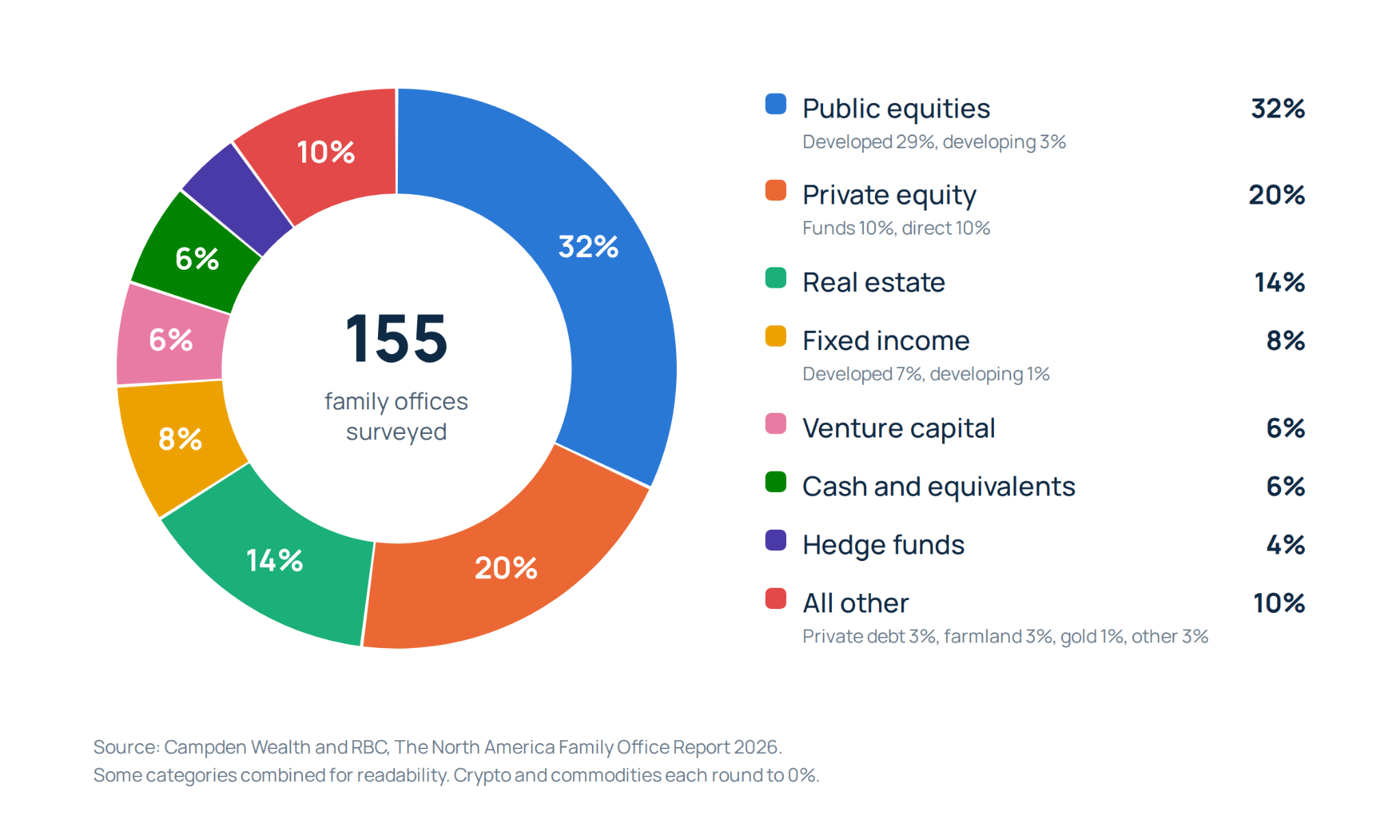
The average portfolio continues to span a wide range of asset classes. Developed-market equities are now the largest allocation at 29%, up seven percentage points from 2024. Real estate accounts for 14%, while private equity funds and direct private equity each account for 10%.
Average asset allocation, 2026
Beyond traditional investments, 39% of family offices also manage one or more passion assets. Art is the most common, followed by aircraft, wine, collectible automobiles, professional sports teams and yachts.
Private markets are moving to direct
86% of family offices invest in private markets, and the mix is shifting. Direct investments now make up 45% of the average private markets portfolio, ahead of funds at 36%. Last year, it was the reverse: 33% direct and 48% funds.
Liquidity is a major part of that story. Of the 15 offices in the survey that attempted to exit a fund position, 47% could not complete the exit as expected, while half faced caps or restrictions. The report notes that the absolute numbers are small, but the pattern points to liquidity becoming a primary concern for private-market investors.
As families invest more directly, the reporting challenge also becomes more complex. Direct investments and private funds bring different reporting schedules, documents and valuation processes, all of which have to come together into a complete view of the portfolio.
AI is moving quickly, but reporting is still manual
AI is the top investment theme of 2026. It is also being adopted inside the family office. More than half of offices, 54%, use AI to research text, news and transcripts, while 38% use it as an aid in investment reporting. Another 36% use AI to collect and manage internal data or create an internal knowledge base.
But the core challenge has not changed. 73% say investment reporting is still too manual, making it a top concern for the third year running. The median IT spend is US$100,000, which the report suggests helps explain why many offices are still under-investing relative to the problem.
The gap is also reflected in the risk outlook. Failure to upgrade technology is the top long-term risk identified by family offices, cited by 51% of respondents.
Cybersecurity jumps to the top of the risk list
Cybersecurity and data breaches are now the top near-term operational concern, cited by 59% of family offices, up from 16% last year. The same percentage experienced phishing attempts, while 25% saw a family member's personal accounts breached.
Manual processes remain a significant concern, too. 44% cite too many manual processes as a near-term operational risk, while 32% point to over-reliance on spreadsheets.
Succession plans are often undocumented
43% of family offices are still controlled by the generation that created the wealth, and among those that have not yet gone through a transition, 52% do not expect one for at least a decade.
But the infrastructure for that transition is often incomplete. Only 25% of family offices have a formal, documented succession plan. Another 52% say their succession plans are informal or in development, while 23% have no plan at all.
The report also highlights that succession extends beyond the family itself. One in three offices is concerned about the retirement of key family leaders and staff, making institutional knowledge and talent transition part of the broader succession challenge.
Family office infrastructure needs to keep pace
The report points to a clear gap. Family offices are investing across more asset classes, moving further into direct private markets and adopting AI, yet investment reporting remains highly manual.
The challenge is not simply having more data. It is bringing investments, entities, documents and workflows together in a way that gives the family office a reliable view of the whole balance sheet.
MYFO brings public and private investments, operating businesses, entities and financial documents into one platform, giving family offices a consolidated view of their wealth. Book a demo to see how MYFO can help reduce manual reporting across your family office.
Source: Campden Wealth and RBC, The North America Family Office Report 2026.
.png)