.svg)
Family offices are under pressure to modernize without bloating budgets. Rising oversight, multi-asset complexity, and next-gen demand for real-time visibility make spreadsheet-era reporting untenable. In 2026, the best fit for most lean operations is a lightweight, cloud-first consolidated reporting platform that automates data flow and speeds decision-making. IQ-EQ’s 2026 family office predictions point to a decisive shift away from legacy stacks toward unified, cloud-native tools built around straight-through processing (STP) for cleaner data pipes and faster closes. STP, or automated processing of transactions without manual intervention, reduces errors and costs by design, not heroics. Below, we break down seven strong options and how to choose the right one for your structure and growth path.
7 Platforms Worth Knowing
MYFO: Best for Agile Single-Family Offices
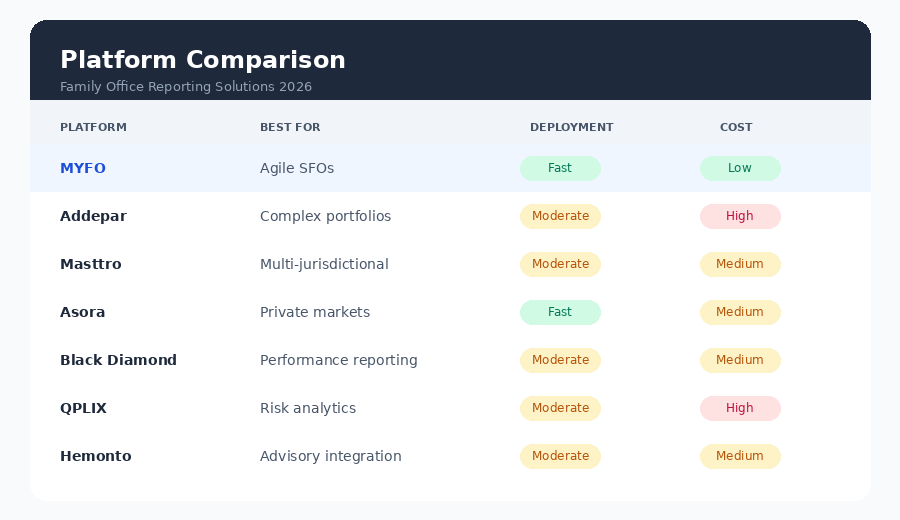
MYFO is designed for single-family offices (SFOs) that want enterprise-grade reporting without unnecessary complexity. It deploys quickly, with a clean, cloud-first interface and transparent pricing that supports truly lean operations. Critically, it decouples reporting from accounting, so you can retain or outsource bookkeeping while still presenting unified, professional reporting across entities and asset classes. Role-based sharing and secure report delivery mitigate the risks of emailing PDFs, a growing concern as next-gen family members enter governance and demand mobile, on-demand access. For small teams seeking speed, clarity, and control, MYFO is the pragmatic choice.
Addepar: Best for Complex, Multi-Asset Portfolios
Addepar is the institutional heavyweight for handling dozens of custodians, alternatives, and derivatives with deep risk, performance, and compliance needs. Expect a longer implementation and higher TCO, but also industry-leading multi-custodial coverage, granular data modeling, and robust analytics. Ideal for offices that require comprehensive capabilities at scale and can support the governance cadence to match.
Masttro: Best for Multi-Jurisdictional Estates
Masttro excels for globally distributed families with intricate entity charts, cross-border holdings, and multi-currency reporting. Its visual estate and ownership mapping, along with flexible consolidation rules, help trustees and principals navigate the complexities. If your operating reality spans time zones and tax regimes, Masttro’s structured approach reduces complexity at its source.
Asora: Best for Private Market Automation
Asora targets private equity (PE) and venture capital (VC)-heavy portfolios with capital call tracking, document ingestion, and a visual “Wealth Map” that equalizes private assets with public holdings. The outcome is faster closes and fewer manual reconciliations across funds, SPVs, and co-investments. It’s a fast-deploy option when private markets drive most of your operational burden.
Black Diamond: Best for RIA-Grade Performance Reporting
Black Diamond offers advisor-grade performance measurement, billing, and custodial connectivity to family offices that prioritize time-weighted returns, sleeve-level reporting, and institutional rigor. It’s a strong fit for offices operating like registered investment advisors (RIAs) or sharing infrastructure with advisory teams that need consistent, auditable performance workflows.
QPLIX: Best for Institutional Risk Analytics
QPLIX provides advanced attribution, scenario modeling, and compliance tracking on a modern data backbone. With STP-native workflows and strong support for alternative assets, it suits offices that want quant-grade analytics without building an in-house data science stack. Expect a moderate deployment timeline and a premium price for the depth of analytics offered.
Hemonto: Best for Advisory-Integrated Reporting
Hemonto combines independent consolidated reporting with an advisory overlay, covering both liquid and illiquid assets while offering expert review to validate data and insights. It’s an appealing choice for families looking for a partner-plus-platform model rather than pure software, particularly where governance benefits from an external second pair of eyes.
Platform Comparison
How to Choose
Map your assets and entities. Inventory every entity, trust, fund, account, and data source. The shape of your diagram, not a feature checklist, should drive the platform shortlist.
Verify custodian feed coverage. Request a live demo that ingests your custodians and alternative data sources. For private assets, prioritize capital call and distribution automation.
Test automated validation. Run pilots with real positions and transactions. Measure how much STP the platform truly achieves and how many manual touchpoints remain.
Align pricing with growth. Assets Under Management (AUM) fees can pinch when markets rise or you add entities. Flat-fee or tiered seats may offer better predictability for multi-entity growth.
Stress governance and security. Ensure role-based access, audit logs, and secure sharing to reduce email exposure and enhance oversight, top operational concerns flagged by Campden Wealth’s Global Family Office Report.
Plan for change management. Favor intuitive UIs and a fast time-to-value; every extra training hour is a hidden cost. Reference IQ-EQ’s call for unified, cloud-native tools to future-proof your tech stack.
The Bottom Line
The “best” platform isn’t the one with the most features. It’s the one that aligns with your operating model today and scales with tomorrow’s complexity. Lean SFOs derive significant value from cloud-first tools that separate reporting from accounting and provide secure, role-based sharing at a low cost. Larger, multi-jurisdictional structures should focus on institutional-grade analytics, coverage, and controls, accepting more time and investment for sustainable depth.
Either way, 2026 is the year to modernize. Legacy workflows aren’t just inefficient; they’re a liability in a world moving to STP-driven, cloud-native reporting.