.svg)
Family offices don’t struggle for lack of tools—they struggle because those tools don’t communicate effectively. Spreadsheets, CRMs, custodian portals, accounting systems, and shared drives create islands of data that teams must stitch together by hand. That’s workflow fragmentation, and it drives delays, errors, and compliance risks. The fastest way out is consolidating portfolio management, document automation, workflows, and reporting into one integrated dashboard that serves as your single source of truth. Done right, you replace rekeying and reconciliation marathons with real-time, role-specific insights so decisions happen sooner and audits run smoother. If your team is spending more time chasing data than analyzing it, an integrated family office dashboard is how you get back to high-value work.
The Real Cost of Fragmentation
Fragmentation compounds because every system, entity, and asset class adds new places for data to drift out of sync. In a typical family office, thousands of recurring processes per billion in AUM create endless touchpoints—each one a chance for duplicate entry, broken links, or a missed deadline.
What that looks like day to day:
- Duplicate data entry across accounting, investments, and compliance tools
- Manual spreadsheet reconciliations that introduce errors and version control issues
- Reporting cycles that slip from days to weeks, frustrating principals and partners
- Misplaced or inconsistent documents that increase audit and regulatory risk
The costs are real. Gartner estimates poor data quality costs organizations an average of $12.9 million annually due to operational inefficiencies and downstream errors, delaying transformation efforts and eroding trust in reporting Gartner on data quality costs. Fragmentation also wastes time: McKinsey finds knowledge workers spend nearly a fifth of their week searching for and gathering information—time that should go to analysis and decisions McKinsey research on knowledge work.
Complex ownership stacks and alternative assets intensify the challenge. As family offices expand into private equity, private credit, and real assets, data becomes harder to standardize and reconcile, increasing governance and reporting pressure UBS Global Family Office Report.
The Fix: One Integrated Dashboard
An integrated family office dashboard consolidates the core of your operating model—portfolio data, document flows, task orchestration, and performance/reporting—into a single, API-connected platform. Rather than swivel-chairing across apps, teams operate from a unified data model with consistent definitions and audit trails.
What changes:
- Automated reconciliation flags exceptions instantly, cutting manual follow-ups and reducing low-value tasks by up to 30%
- Reporting cycles collapse from weeks to minutes through standardized templates and live, validated data
- Role-based dashboards ensure each stakeholder sees only what they need—principals, investment teams, accountants, and advisors work from the same truth
- Encryption and immutable activity logs reinforce compliance and security by design
This approach also tames app sprawl. Enterprises continue to accumulate hundreds of applications, stretching workflows across disconnected silos Okta Businesses at Work. A dashboard that aggregates accounts, entities, and assets into one pane of glass restores control without adding yet another standalone tool. Role-based access controls follow best-practice models such as NIST’s RBAC, mapping privileges to responsibilities to reduce privacy and insider-risk exposure NIST RBAC model. And comprehensive logging and encryption align with recognized controls for accountability and data protection NIST SP 800-53 security controls.
Features That Matter
Not every platform delivers. Here's what to prioritize:
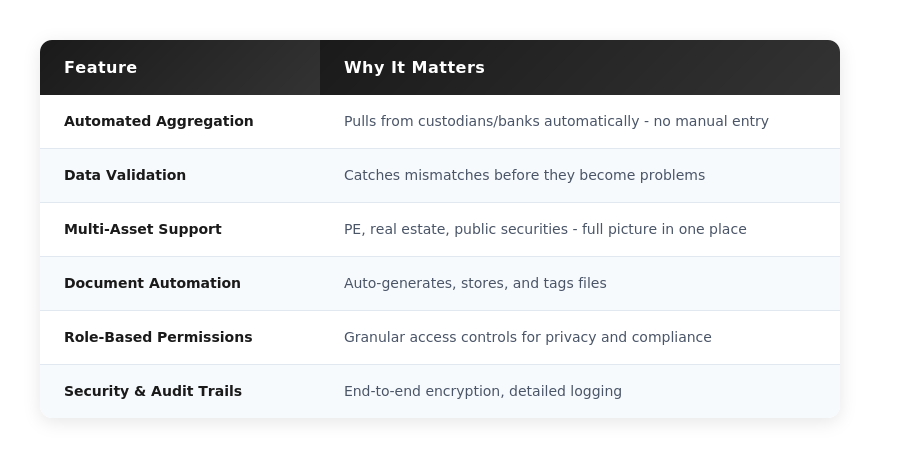
Traditional CRMs and ERPs weren’t built for family office complexity. Purpose-built platforms, like MYFO, outperform generic systems because they model multi-entity ownership, handle alternative assets, and support family governance and privacy needs out of the box—without layers of brittle customizations.
Implementation: Start Small, Scale Fast
You don’t need a big‑bang rollout. A phased, pragmatic approach de‑risks the transition and accelerates adoption.
- Map current pain points
Interview teams and trace a few recent reporting cycles to pinpoint where delays, errors, and duplicate work originate. - Choose the right platform
Favor API‑driven aggregation and reconciliation, templated dashboards, and a flexible data model that supports multi‑entity, multi‑asset scenarios. - Integrate incrementally
Start with the highest-friction workflows (e.g., statement aggregation, capital calls, month‑end close) and connect a handful of critical data sources first. - Pilot before scaling
Run pilots on capital calls and monthly reporting to validate data flows, refine permissions, and prove time-to-value with a small group. - Train with real scenarios
Use live family data in short, role-specific sessions so teams practice exception handling, approvals, and reporting flows they’ll use daily. - Retire legacy tools strategically
As confidence builds, phase out redundant spreadsheets and portals, consolidating processes into the dashboard to prevent backsliding.
Measuring Success
Track the signals that matter and review them quarterly:
- Reporting turnaround: Move from multi-week cycles to same-day or scheduled, on-demand reporting.
- Reconciliation exceptions: See exception volumes and resolution times decrease month over month.
- Manual task reduction: Target a 30%+ reduction in low-value tasks through automation and straight-through processing.
- Audit readiness: Maintain complete audit trails so you’re always exam-ready, not scrambling quarterly.
Use your dashboard’s analytics to identify bottlenecks, refine workflow routing, and update templates based on real usage—not assumptions.
The Bottom Line
Workflow fragmentation is more than annoying admin—it’s expensive, risky, and unsustainable as your office scales. One integrated dashboard replaces chaos with clarity: fewer systems to reconcile, faster reporting, stronger governance, and more time for actual analysis. MYFO delivers exactly this: AI‑driven reconciliation, automated reporting, and a unified view across entities—purpose‑built for family offices that need enterprise capability without enterprise complexity. Stop managing around your systems. Start managing through one.