
.svg)
The San Diego Padres just sold for a record $3.9 billion. But the story behind the sale is not really about baseball. It is about what happens when succession planning fails at the worst possible moment.
A succession dispute that forced a sale
The biggest family office story of the quarter did not start as a business deal. It started with a death and the conflict that followed. When Peter Seidler, owner of the San Diego Padres, died in November 2023, he left behind a beloved franchise and a succession plan that quickly unravelled. His wife Sheel sued her brothers-in-law Matthew and Robert in an attempt to prevent John Seidler from becoming the team's control person. The legal conflict dragged on for months, paralysing decision-making at the ownership level and making it increasingly clear that a negotiated family resolution was not possible.
The Seidler family had owned the Padres since 2012. Peter Seidler was known as a hands-on, genuinely passionate owner who invested heavily in the team and built real goodwill with the San Diego fan base. The dispute that followed his death was not the result of negligence or a lack of planning. It was the result of a governance structure that had not anticipated what would happen when heirs disagreed about control, and had no clear mechanism for resolving that disagreement without litigation.
The record-breaking sale
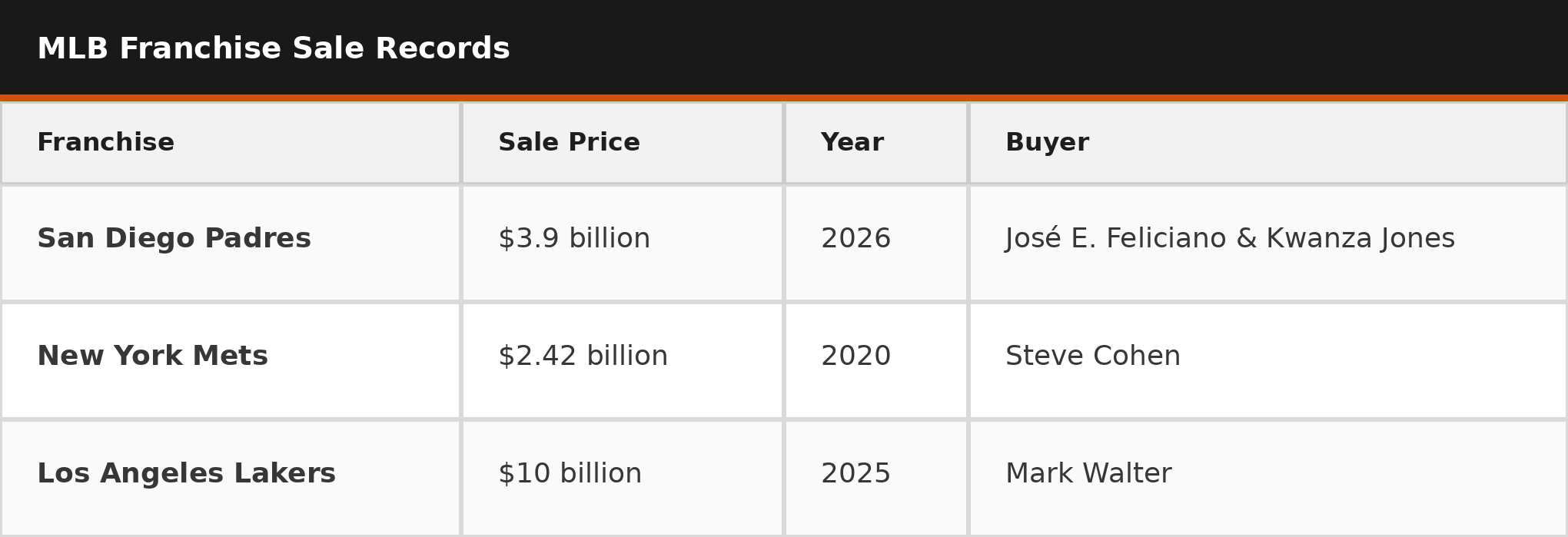
José E. Feliciano and his wife Kwanza Jones agreed to buy the Padres for $3.9 billion, shattering the previous MLB record of $2.42 billion set when Steve Cohen bought the New York Mets in 2020. The deal values the Padres at roughly 60% more than the previous record, reflecting both the extraordinary appreciation in franchise values across professional sports and the premium that comes with a trophy asset sold under pressure.
What makes the deal notable beyond the headline number is the profile of the buyers. Feliciano and Jones are not a private equity fund or an institutional consortium. They are co-founders of a private family office established in 2014, with Jones serving as CEO. The capital came entirely from their personal balance sheets. No fund. No LP capital. No external timeline pressure. This was personal wealth deployed at a scale that very few individuals in the world can match.
What family offices should take from this
The Seidler story is not an outlier. It is a pattern. A founder builds something extraordinary. The asset appreciates enormously. The estate plan is structured and the legal documents are in place. But the governance question, specifically who controls the asset when the founder is gone and heirs disagree, is left unresolved. It gets deferred because it is uncomfortable, because it requires difficult conversations, and because in the moment it never feels urgent.
Until it is.
The tools to prevent this outcome exist. Clear control structures that specify decision-making authority. Dispute resolution mechanisms that do not require litigation to function. Buy-sell agreements for illiquid assets that give heirs a structured path to liquidity without destroying the asset in the process. Family governance frameworks that separate emotional relationships from legal ones.
The Seidler family had structure. What they did not have was a mechanism that could survive the moment when heirs stopped agreeing. That distinction is worth examining in every family office portfolio that holds a significant illiquid asset.
MyFO's entity map gives families a clear view of how assets are owned across trusts, LLCs, and holding companies — creating space for discussion before questions about control and succession become a surprise. And when a significant portion of net worth is tied up in illiquid positions, MyFO surfaces that concentration directly, while there is still time to act.
The tools exist. The question is whether families use them before the moment arrives when they have no other choice.
.png)
.png)
.png)
.png)